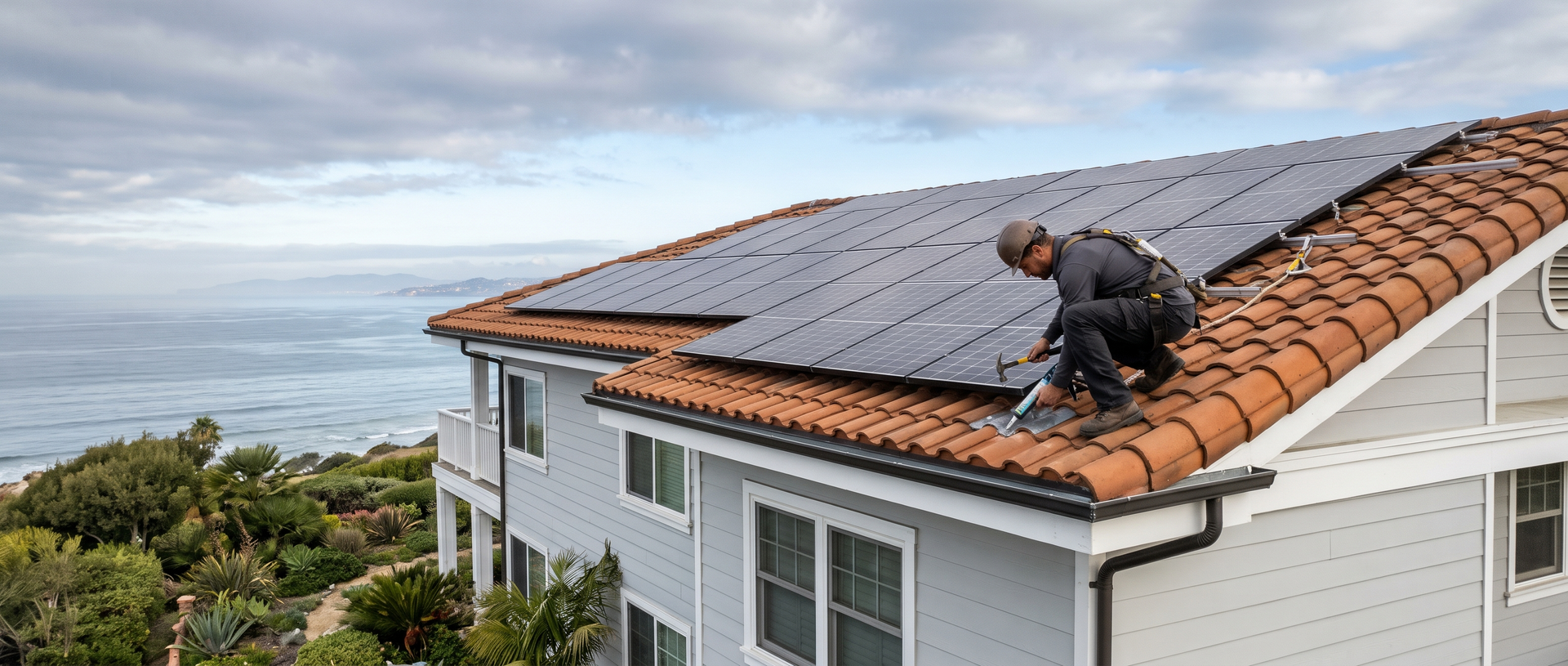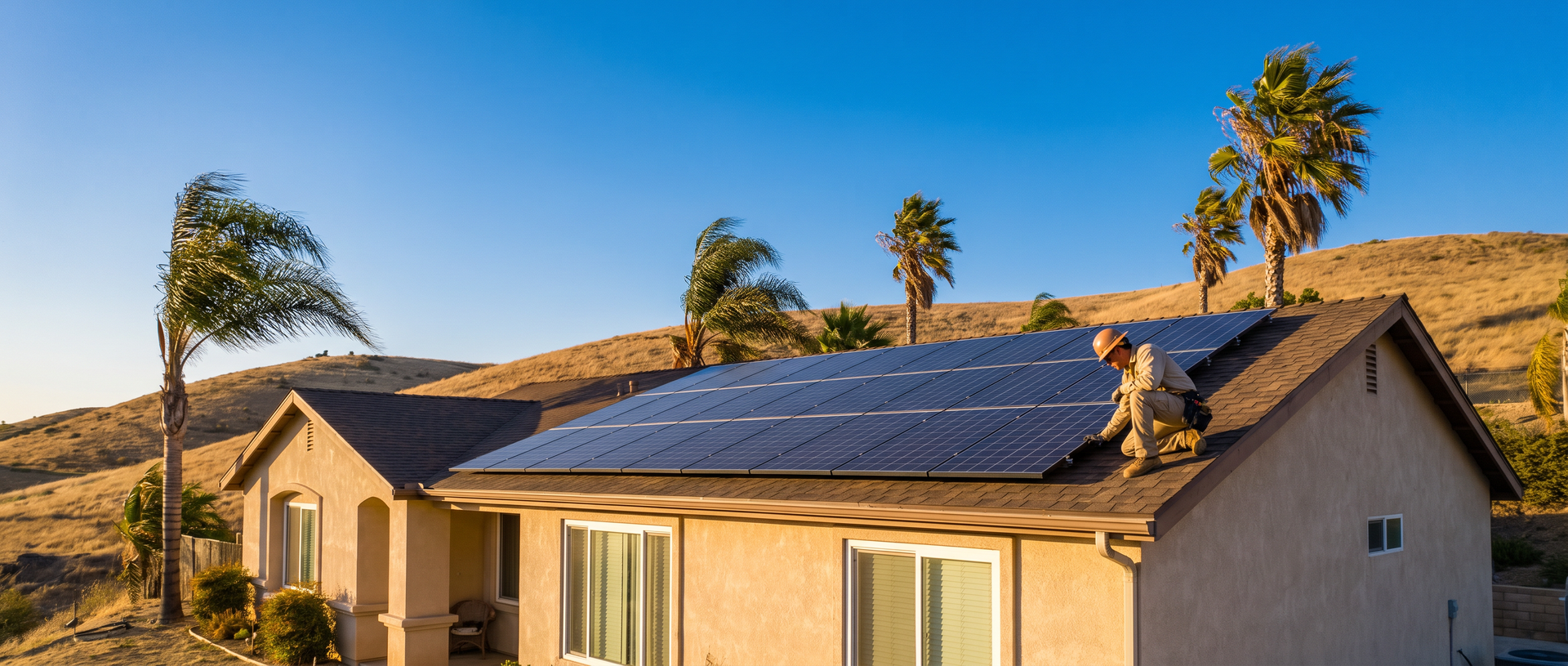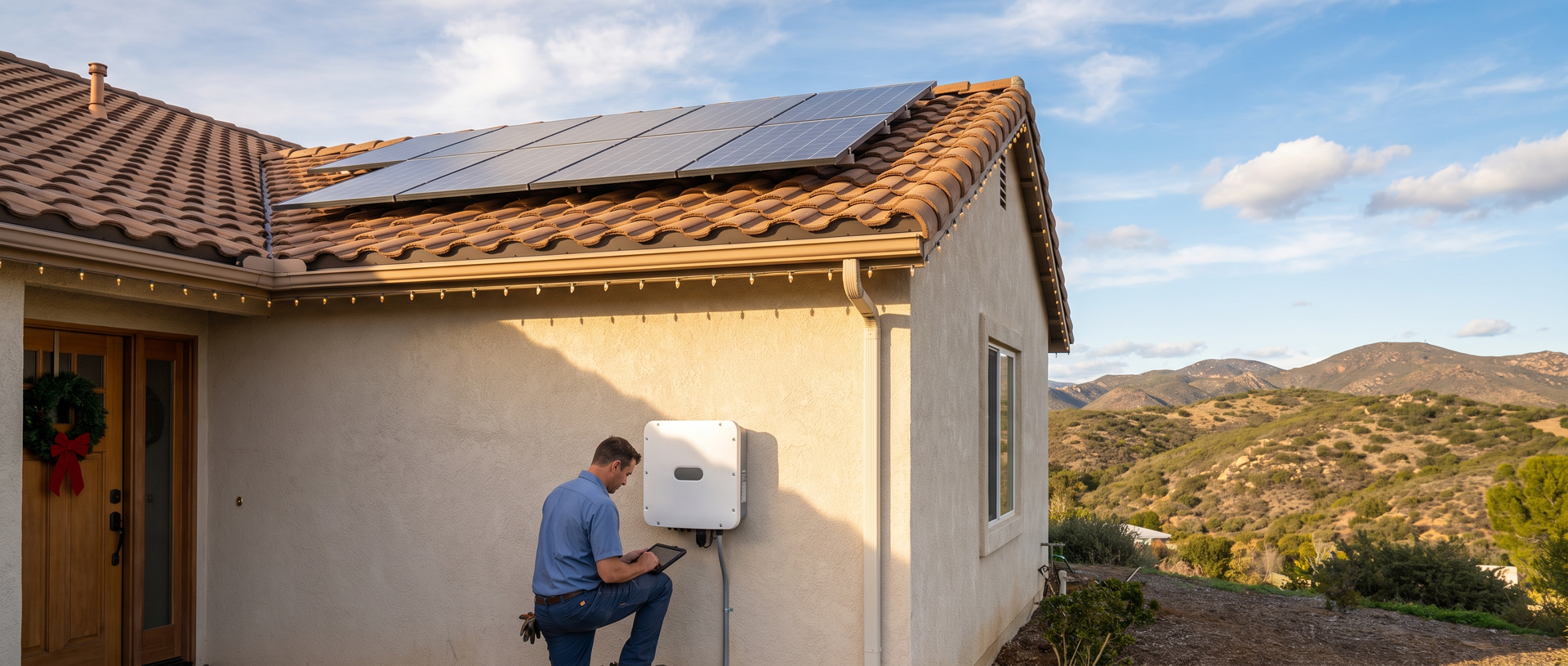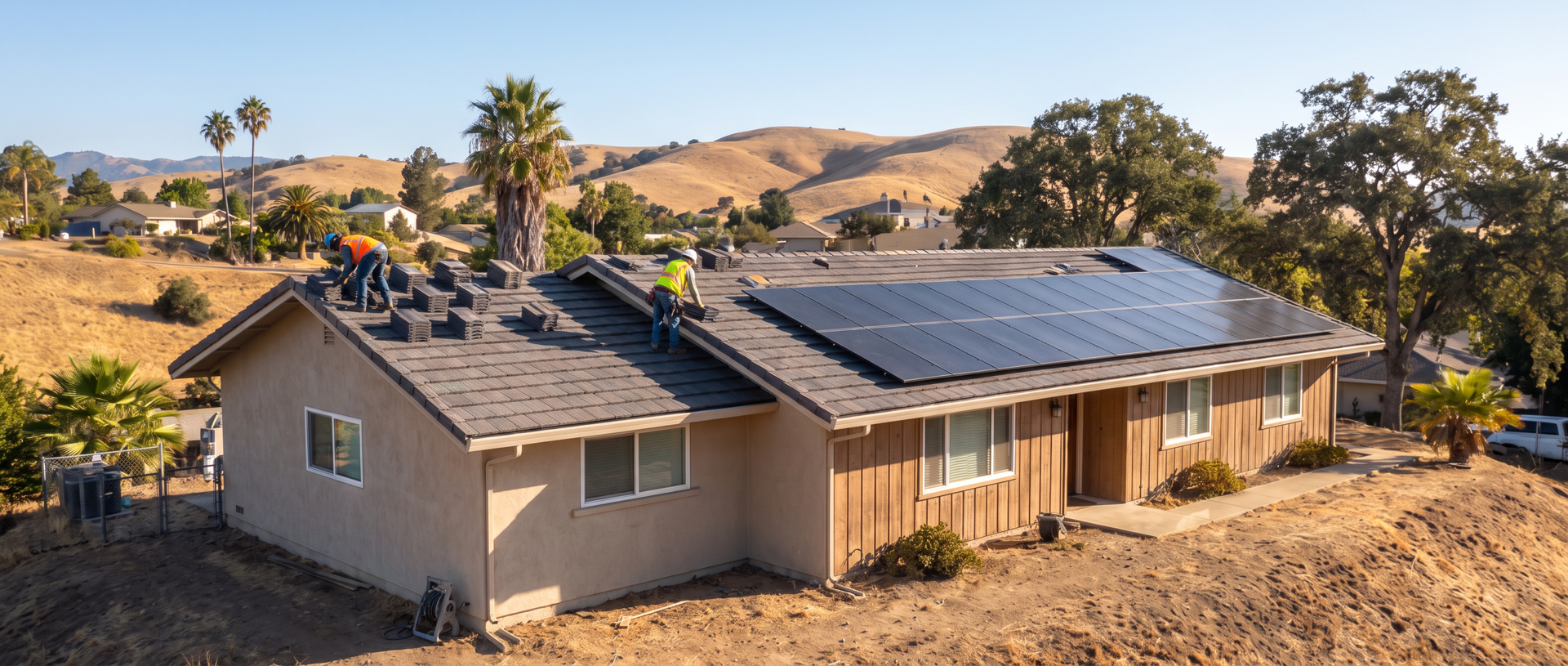

A roof leaking around solar panels is one of the most stressful surprises an El Cajon homeowner can find. One brown stain on the hallway ceiling, and suddenly you're wondering whether solar was a mistake.
Take a breath. Leaks at solar standoffs usually trace back to a few specific causes, and most can be diagnosed and repaired properly. Here's what's likely happening and what to do next.
If water is dripping right now: move belongings, set out a bucket, and photograph the stain and the attic area if it's safe to reach. Please don't walk the roof yourself. Panels, wiring, and tile or shingle surfaces make it risky.
Three Situations Behind Most Standoff Leaks
Crews usually hear one of three stories. See which one sounds like yours.
- The first-big-storm leak. The system went in during the dry season. Months later, the first heavy winter rain finds a flashing gap that nobody could see in July.
- The slow-fade leak. Your system has been up for years. Sealant around the mounts has dried, cracked, or pulled away under relentless inland sun.
- The someone-was-up-there leak. A roofer, pest crew, or cable installer walked the roof. Now there's a cracked tile or lifted shingle next to a mount.
Homeowners from Santee to La Mesa describe these same patterns. To understand who you'd be working with, read more about Sunline Energy's roofing and solar team.
This helps homeowners describe the problem clearly, which speeds up a good repair.
Matching a Roof Leaking Around Solar Panels to the Right Fix
A standoff is the post or bracket that anchors the solar racking to your roof framing. Every standoff is a hole in your roof, and every hole depends on flashing and proper sealing to stay dry.
| If You're Seeing This | Likely Cause | What a Proper Repair Involves |
|---|---|---|
| A stain only after heavy rain | Missing, lifted, or poorly lapped flashing | Re-flashing the mount so water sheds downhill |
| A leak on an older system | Sealant that has dried or separated | Removing old sealant and resealing or re-flashing |
| A leak near a tile roof mount | Cracked or poorly cut tile over the standoff | Replacing tiles and checking the underlayment |
| A leak plus a loose or shifting mount | A lag bolt that missed or loosened in the rafter | Re-anchoring into framing and sealing the old hole |
Notice a pattern? Sealant alone is rarely the full answer. Flashing does the real waterproofing work, and sealant is the backup. You can explore Sunline Energy's roofing and solar services to see how both trades come together.
This matters for homeowners who want a fix that lasts, not one that just survives the next storm.
Why East County Weather Is Hard on Solar Mounts
El Cajon sits in an inland valley that runs much hotter than the coast. Roof surfaces heat up in the afternoon and cool off at night. That daily expansion and contraction slowly works on sealants, fasteners, and tiles.
Then winter flips the script. Rain often arrives in heavy bursts after long dry stretches. A small flashing flaw can hide for months, then show up the first night of real rain.
Santa Ana winds add another layer. They push leaves and debris under arrays, where it can dam water around the mounts. It's not glamorous, but keeping the area under your panels clear really matters.
This benefits East County roofs that see both extremes every year.
What a Proper Repair Looks Like, and What Comes After
A lasting repair follows a clear sequence:
- Trace the water path. Water often travels along rafters before it shows on a ceiling, so the attic and roof are checked together.
- Remove affected panels when needed. This gives direct access to the mounts and the roof beneath them.
- Repair the roof, then the mounts. Flashing, underlayment, and roof covering are corrected, and standoffs are secured into framing.
- Reinstall and verify. Panels go back on, wiring is checked, and the system's production is confirmed.
Some repairs, especially those involving roof replacement or electrical work, may require permits and inspections. Before anyone starts, gather any installation and roofing paperwork you have, since terms differ between providers.
After the repair, watch that spot during the first rain. Then do a quick visual check after major storms each year. When one team handles both the roof and the solar, there's no finger-pointing between trades. Questions anytime? Reach out to Sunline Energy support.
This helps homeowners who want one accountable team, start to finish.
Common Questions About Solar Standoff Leaks in El Cajon
Why is my roof leaking around my solar panels?
Most leaks around solar panels start at the mounting points, called standoffs. Common causes include missing or lifted flashing, aged sealant, cracked tiles, or a lag bolt that missed the rafter. El Cajon's heat swings and sudden heavy rains tend to expose those weak spots.
Can a roof leaking around solar panels be fixed without removing them?
Sometimes, but the affected panels often need to come off. Flashing and underlayment sit beneath the array, and proper repairs usually require direct access. A careful removal and reinstall lets the roof be repaired correctly instead of patched from the edge of the array.
Is caulking my solar standoffs enough to stop the leak?
Usually not on its own. Sealant is a backup, while flashing is what actually sheds water away from each penetration. Caulk over a flashing problem may hold through East County's dry months, then fail once winter storms roll back in.
How soon should I get a solar panel roof leak checked?
As soon as you notice it, ideally before the next rain. Water can soak decking, insulation, and drywall well before a stain appears. Tracing the source early in La Mesa, Santee, or Lakeside usually means a simpler, less disruptive repair.
Getting Past the Leak With Confidence
A roof leaking around solar panels feels like a crisis, but it's usually a specific, fixable problem at a specific spot on your roof. If the flashing failed, it gets re-flashed. If a mount shifted, it gets re-anchored. Either way, you can get back to a dry ceiling and a system you trust.
Once your roof is sound again, you can explore what else Sunline Energy offers. And if a neighbor ever asks who fixed yours, the Sunline Energy referral program makes it easy to pass the name along.
Ready to Take the Next Step?
Have one team look at both your roof and your solar system, trace the leak to its source, and repair it the right way.